Bringing an irrigation specialist for garden designers into a project early can prevent costly changes and help each planting area receive the right amount of water. Irrigation should be part of the technical garden design – not an add-on once construction is already underway.
When should an irrigation specialist join the project?
Ideally, before groundworks and hard landscaping begin. A garden irrigation specialist can review the layout, planting plan, water source, pressure, levels and proposed surfaces while pipe routes are still easy to coordinate.
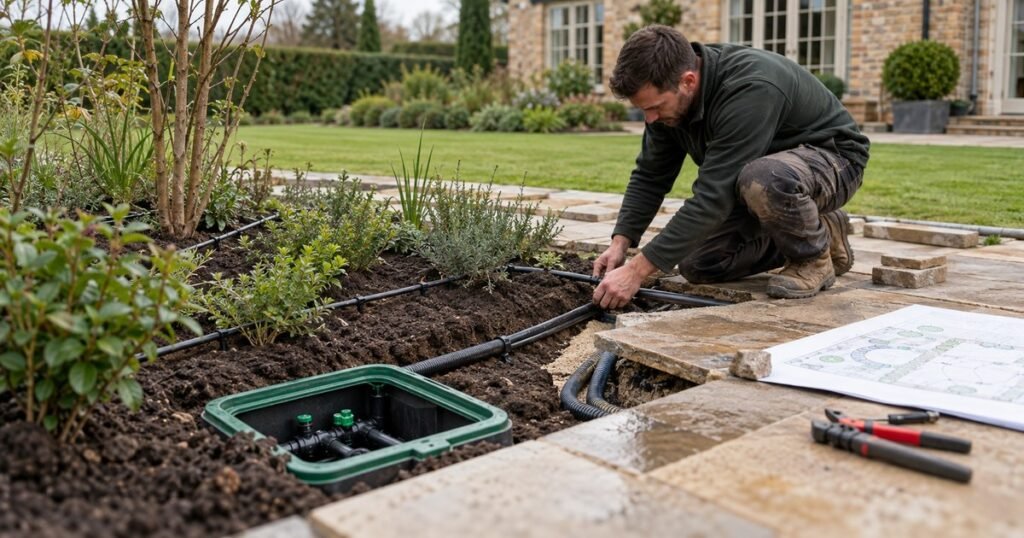
Early input allows pipework, valve boxes, sleeves and controllers to be planned alongside paving, planting and electrical works. This can avoid lifting finished surfaces or redesigning established beds later.
What information should designers provide?
| Information | Why it matters |
| Site and planting plans | Defines coverage and plant groups |
| Water source and pressure | Determines system performance |
| Levels and slopes | Affects pressure and runoff |
| Hard landscaping plan including electrical connections | Helps plan pipe routes |
| Plant requirements | Supports accurate zoning |
| Mulching | Hide surface pipework |
| Scheduling | Affects attendance |
A good irrigation system design follows the landscape. Lawns, hedges, borders and trees often need different watering methods and run times. For more detail, see How to Design a Garden Irrigation System for Efficient Watering.
Coordinating irrigation with landscape construction
A landscape irrigation specialist should work with the wider project team. Sleeves may need installing beneath paths before paving, pipework must avoid other services and planting pits, tanks, pumps and controllers require a suitable location and power supply.
This coordination also supports water-efficient garden design. Drip irrigation can target planted borders, while correctly positioned pop-up sprinklers can provide appropriate lawn coverage.
Installation, testing and handover
After irrigation installation, pressure and coverage should be tested, individual zones checked and the controller programmed. The client should also understand seasonal adjustments and future maintenance requirements.
The Gardener’s Rain provides Irrigation System Installation & Design, covering the process from survey and system planning through installation, controller setup and aftercare.
Designer’s irrigation checklist
- Involve the irrigation specialist before groundworks.
- Share site, planting and level plans.
- Confirm water source, flow and pressure.
- Identify lawn, border, hedge and tree zones.
- Coordinate pipe routes with paving and other services.
- Agree controller location and electrical requirements.
- Confirm testing, handover and maintenance.
Questions to ask an irrigation contractor
Ask how irrigation zones are calculated, how water pressure is assessed, which methods suit each planting area, how they coordinate with other contractors and what aftercare is included. A good technical partner should be able to explain these decisions clearly.
FAQ
Can irrigation planning wait until the garden is built?
It can, but early irrigation planning for landscape projects usually reduces disruption and the risk of lifting completed surfaces.
Should lawns and planted borders share the same zone?
Usually not. Their watering methods and run times differ, so separate zones provide better control.
Can an irrigation specialist work from a garden designer’s plans?
Yes. Plans provide an excellent starting point when supported by information on levels, water pressure, hard landscaping and existing services.
Build irrigation into the design from the start
Treating an automatic irrigation system as part of the landscape infrastructure helps protect the planting design and simplifies project delivery. Send The Gardener’s Rain your garden plans for an initial consultation or arrange a site survey to integrate irrigation before construction begins.